Theme 5: Your vision of leadership

John Maxwell (1998) once quoted, “A leader is one who knows the way, goes the way, and shows the way”. A leader, helps in building trust, collaboration, interdependence, motivation, and mutual responsibility towards achieving success. Most smart choices and good decisions are made with clear visions in mind and the vision engraves the ability to see the greatness in others compared to one selves and emphasizes on the need for others to grow and creates an opportunity for organizational change that goes beyond contribution of an individual (Guidroz et al. 2010). Beer (2009), argued that leaders who treats their employees as valuable assets, forms a learning culture, and motivate their subordinates, experienced an improvement in their organization’s performance and employee’s commitment.

Transformational (TLS) and Democratic leadership style (DLS) will be the most ideal leadership technique that I would practice as a leader in future. As the world continuously progresses and organizations globalize, TLS and DLS would be the most effective method in managing teams that comes from various demography and geography. Sharing the vision and communicating effectively will be one of the key traits of critical success factors of a good leadership. The key characteristics of TLS and DLS is as follows:

Figure 1: Tan Sri Tony Fernandes (Source: Google)

Tan Sri Tony Fernandez will be my biggest inspiration of an effective leader as he is a brilliant leader. His way of leading people is unquestionably different from other leaders.  He adopts a management style that he walks more than he sits on his desk and believes in working hand in hand with the employees. There is no special room for his office, instead having his own cubical and sits together with his fellow staffs. He is humble and learns new things about the airlines every day as he loves walking around. Tony is easily approachable and accessible to all his staff, bureaucracy is eliminated to reduce the power distance and all employees are free to access his office if there is anything important to be discussed. The work culture led by Tony Fernandes has brought positive impact to the growth of AirAsia and the employees are very much keen to progress in the same direction. Contributions of ideas are well accepted and the management rewards the outstanding ideas. In short, Tony’s leadership highlights the importance of having a good interaction towards his all-stars (employees) and eliminates hierarchy practice in AirAsia (Kamisan, A. and King, B. 2013).

Figure 2: Leadership Performance Indicator (Source: Constructed by writer)

Based on my leadership performance indicator which was evaluated by my fellow team mates, it shows that my strengths lies in enabling and encouraging others. The projection could be highly true as I am an attentive listener, who likes to treats others with respect and dignity, always supports and get consensus before making a decision. However, in the direction of becoming a good leader I should find my ways in improving the other three traits that has been a pull factor towards my performance such as to accept challenge. In becoming an effective leader, I would need to accept new challenges or responsibilities so that it could be an inspiration to others and my team to do the same.

Figure 3: 16 Personality Test (Source: Constructed by writer)

Based on the 16 personality test shown in figure 3, it shows that my personality type are towards Assertive Consul where I thrive on social order and harmony that uses social intelligence to ensure everyone knows their responsibilities and able to get the job done. Consul personalities expect authority to be respected and backed up by rules and standards. It also indicates that I am a highly an extraverted and assertive person.  I prefer working in group activities and get energized by social interaction as it boost my enthusiasm and excitement. I am can work in high pressured environment and turbulent towards completing my tasks even if I had to work day and night.

Leadership skills that I want to develop through the MBA.

As I progress through the MBA, I’m keen on developing the skills of inspiring others by setting a good example by being positive, stay calm under pressure and keep the motivation level up and through this approach it should be visible through my actions. Besides inspiring others, I would like to see myself as a good communicator and by acquiring this skill, I will be able to motivate my team mates and encourage them to think out of the box in achieving better results. Lastly I would like to cultivate creative thinking and constant innovation that makes me and my team stand out from the crowd.

Conclusion.

To conclude, the subject leading in a changing world has provided a well-rounded approach on leadership and management which is relevant to any profession.  I am determined to apply the knowledge that I have learn from the class for the past 10 weeks by converting my weaknesses to strengths. An effective leader is not created overnight, as such, ample of determination and persistence required in becoming one and the most important lesson that everyone should take back is, being humble even if we have reached at the peak of our success.

(769 words)

References

Beer, M. (2009), “High commitment high performance: how to build a resilient organization for sustained advantage”, Jossey-Bass, San Francisco, CA.

Guidroz, A., Luce, K. and Denison, D. (2010) “Integrated Change: Creating Synergy Between Leader And Organizational Development”. Industrial And Commercial Training 42 (3), 151-155  [10 July 2019]

Kamisan, A. and King, B. (2013)”Transactional And Transformational Leadership: A Comparative Study Of The Difference Between Tony Fernandes (Airasia) And Idris Jala (Malaysia Airlines) Leadership Styles From 2005-2009″. International Journal Of Business And Management 8 (24)

News, A. (2019) Airasia CEO: Positive Thinker, Unusual Leader [online] available from <https://news.abs-cbn.com/business/11/18/15/airasia-ceo-positive-Wajdi, B. (2017) “The Differences Between Management And Leadership”. Sinergi : Jurnal Ilmiah Ilmu Manajemen [online] 7 (1). available from <https://www.researchgate.net/publication/318597967_The_Differences_Between_Management_And_Leadership&gt; [27 June 2019]

16 Personalities (2019) ‘Free Personality Test’ available from < https://www.16personalities.com/free-personality-test> [15 July 2019]

Leadership & Change

Management in organization and companies has seen a paradigm shift in recognizing the importance of change. In this era of globalization, an organization’s survival is critically dependent on practices of rapid change and instant access to information. Aristotle once commented on change that to evolve constantly, the fundamental human nature keeps changing in accordance to situations and needs. According to Mullins (2013:712)It is all down to the personality of the individual and there is little management can do about resistance to change”. We all have to agree at a point where change is as an unavoidable to both, the social and the organizational life and each and every person is subjected to the unremitting change. In response to this statement, I disagree that management has very little to do in resistance to change. For the fact that, Management has a significant role to play as forces changes in an organization.

The outcome of this change could be positive or negative conditional to how a person reacts to it. Those who accepts change, could lead to positive development and for those who refuses, may show the indications of resistance, stress, or even skepticism (McKay 2013).

Resistance to change

Figure 1: Resistance to change (Source : Constructed by writer)

Management play a crucial role to stimulate, encourage and inspire the process of change for the upward mobility of an organization. There are 2 change models that can apply in adopting change in an organisation, namely Lewin’s 3-Steps of Change by Kurt Lewin (1947) and Kotter’s 8-Steps of Change by John Kotter (1996). 

Figure 1: Lewin’s 3-Steps Change Model (Source : Constructed by writer)

According to Hossan (2015), Lewin’s model is inadequate to certain extend and lack of rational sense where human feelings are not prioritized and applies to isolated change in management and it is perceived as looking good on the surface and not in depth. In addition to that the model is too autonomous, one-dimensional and not pertinent towards company that practices continuous change for example technological companies.

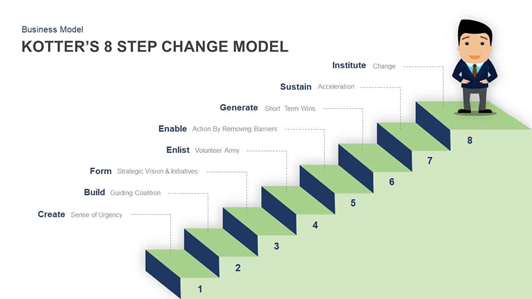
Kotter’s 8-Steps Change Model


Figure 3: Kotter’s 8-Steps Change Model (Source : Kotter 2018)
1
Facilitate and communicate effectively on the significance and needs of change.
2.

Build alliance with positive people in guiding, coordinating and communicating on the needs for change and managing the perceptions professionally.  
3.

Imposing initiatives to distinct the differences of past and future with the changes that is about to happen.
4.

Create programs to support the new changes towards moving into the same direction and making decisions con-sensually.  
5.

To get rid of unproductive processes and to make clear on the benefits to achieve the new goal setting or changes.  
6.

Continuous trailing and energizing the team and perhaps recognizing the efforts that has been shown towards the changes.
7.

Sustain the acceleration of vibes, motivation and looking into improving structures and policies.
8.


Upon success in eradicating the force of resistance, the management is to acknowledge the accomplishment contributed towards the success and reinforcement is continuously reviewed to ensure old habits are discarded.

Limitation of Kotter’s 8-Steps Change Model.

Kotter’s 8-Steps Change Model is skewed towards inflexibility and the steps are to be adhered sequentially. The resistance continues in an organization if the steps are not followed numerically and may consume time to restart from the start or even stay stagnant on a particular and this makes it impossible to proceed to the next level (Appelbaum 2012). In addition to that, some steps are not relevant in certain circumstances such as changes that relates to technological advancement and neglects scenarios at times of difficulties that is not applicable out of  Kotter’s 8-Steps Change Model radius.

Figure 4: SHELL Refinery (Source : Google image)

Shell

During the oil crisis in 2014, SHELL was in the brink of disaster and the share price tumbled drastically. After the Sir Philips Watts departure, the new group chairman, Jeroen van der Veer was elected and made a drastic, change in management. 80 Shell operating units was at dire risk and the change in management was a recovery plan to save the units. Leaders who are involved in the recovery process had to be determined and ensures ll the departments stayed in track. The special designated team of experts chosen for the job performed extraordinary in driving the behavior of subordinates for the needed changes to succeed. Remarkably. Jeroen Van der Veer and his change in management, recovers SHELL from the disastrous period and without his techniques and determination the company would not still be where it is today (Arnold 2015).


Figure 4: BLOCKBUSTER Inc (Source : Google image)

BLOCKBUSTER (1985 – 2010)

Blockbuster Video, was founded in 1985 and their primary service was home movies and video game rental. Blockbuster was arguably one of the most iconic trademarks in the video rental space with over 80,000 employees and over 9,000 stores worldwide. Back in 2000, Netflix approached Blockbuster with an offer to sell their company to Blockbuster for US$50 million and the CEO of Blockbuster refuses because he thinks it was a very niche market and Netflix was in the brink of collapse. Due to the resistance in change towards a digital market, Blockbuster filed for bankruptcy in 2010 and as of today, Netflix has over 100 million subscribers and the revenue generated is over US$ 8.8 billion.

Conclusion.

To conclude, change is inevitable and it helps in restructuring, cultivates creativeness and enhances the innovativeness by eliminating the obsolete power structures that are highly likely to mislead a company’s resources and directions (Harvard Business Review 2010).

(748

References.

Appelbaum, S. (2012) ‘Back To The Future Revisiting Kotter’s 1996 Change Model’ Journal Of Management Development [online]. Available from <https://www.researchgate.net/publication/242339672_Back_to_the_future_Revisiting_Kotter’s_1996_change_model&gt; [9 July 2019]

Arnold, P. (2015) The 5 Greatest Examples Of Change Management In Business History [online] available from <https://www.managers.org.uk/insights/news/2015/july/the-5-greatest-examples-of-change-management-in-business-history&gt; [14 July 2019]

Harvard Business Review (2010) Change For Change’s Sake [online] available from <https://hbr.org/2010/06/change-for-changes-sake&gt; [9 July 2019]

Harvard Business Review (2010) Decoding Resistance To Change [online] available from < https://elearning.newinti.edu.my/bbcswebdav/pid-3392356-dt-content-rid-12077044_1/courses/MYI1.INTM05LON.GB1.SEP2018.IICS/MYI1.M005LON.FS1.JAN2016.IICS_ImportedContent_20160104022846/08%20Ford%20n%20Ford%202009%20-%20Decoding-Resistance-to-Change.pdf&gt; [10 July 2019]

Hossan, C. ‘Applicability Of Lewin’s Change Management Theory In Australian Local Government’. International Journal Of Business And Management [online]. Available from <https://www.researchgate.net/publication/277945417_Applicability_of_Lewin’s_Change_Management_Theory_in_Australian_Local_Government&gt; [10 July 2019]

Kotter (2018) 8-Step Process [online] available from <https://www.kotterinc.com/8-steps-process-for-leading-change/&gt; [11 July 2019]

Millegan, C., Berry, P., Burnett, J. and Williams, R. (2016) “Blockbuster Failure! Ignoring Innovation Is Not A Strategy.”. Academia [online] available from <https://www.academia.edu/36564159/Blockbuster_Failure_Ignoring_Innovation_is_Not_a_Strategy&gt; [12 July 2019]

Most Effective Leadership and Management Styles and Approaches.

The differences between leadership and management is an ongoing area that are being argued for decades. Universally, leaders do not take up managerial positions nor the managers exercise leadership in managing their subordinates. Bass (2010) argued that leadership and management are overlapping and the functionality of both differs entail a unique set of activities.

Managers – According to Katz (1955), managers are more focused on task orientation, staff development and staff mentoring and a manager’s role, is to provide direction in an organization through a role of supervisory, administrative and executive. Kotter has described a manager is responsible in the direction of planning, organizing, monitoring and coordinating activities of their respective subordinates in an organization (Kotter 2001).

Leaders – gives importance on motivation, and inspiration (Kotter 1990) and a leader aims in creating passion towards their vision and reaching long term goals by taking risks in accomplishing short term goals (Bennis and Nanus 1997). Critical qualities such as integrity, visionary, decisive, faith, obligation, selflessness, and communication ability are the characteristics of a leader (Capowski 1994).

Generally a leader is an individual who do the right thing by creating room of changes to their followers. Management on the other hand, does things right by managing the process flow in authority and functional relationship. The prominent differences between leaders and management is, a leader take risks and creates vision while managers control risks and creates goal to achieve an organization mission (Mullins 2010). One of the most useful management model that is still being used since the early 20th century, ‘The Henri Fayol 5 functions of management Model’. Henri Fayol recognized the job of managers into 5 categories namely, planning, organizing, commanding, coordinating and controlling (Godwin 2017).


Figure 1: The Henri Fayol 5 functions of management Model

Management Styles & Approaches

With reference to CMI 2013 statement, I agree to the statement that there is no distinct or ideal way, as the finest style varies in accordance to circumstances and individual characteristics (CMI 2013). In order to lead effectively, a leader should ensure continuous engagement and good communication skills with their respective subordinates that comes from various background and success can only be achieved if a team is led by a leader who possess good facilitation and influencing techniques. This traits can be found in transformational leadership style, where a leader exhibits traits in challenging the norms and motivates their subordinates with direction and purpose to achieve the vision and mission and goals of an organization (Abdelrahman 2018). On the other hand, democratic leadership focusses on sharing ideas and making decisions collectively and observes openness between a leader and their subordinates. Democratic leadership style emphasizes on participation rate and an ideal democratic leadership surroundings will uphold friendliness, helping each other, and encouraging participation among peers (Luthar 1996). Both of these leadership styles encourages participation (team work) and involvement that results high morale and team spirit culture. However, every leadership style has their limitations.

Transformational Leadership (Limitations)

Effectiveness: In an organization when an employee sees their leader as a common man, the probability of that a transformational leadership style might not be effective is high (Lombardo 2018)

Risky: If the leader has bad plans, followers might be deceived and be lured to go with whatever decisions the leader makes. charismatic transformational leader can be made to fulfill the vision of their leader even if this is deceptive and without merit

Democratic Leadership (Limitations)

Being indecisive: Democratic leadership every now and then encounters being indecisive. In some situation, a leader must be very directive during predicament, and this creates dissatisfactions among team members as authoritarian leadership style do not function well in an democratic leadership style. 

Time Consuming: The process in discussion could result procrastination. A democratic leader is unable to work within a timeframe required, especially working on a project or attending an urgent issue. Due to their democratic nature, it consumes time to talk and collect variety of opinions within their team and many democratic leaders find it difficult to manage time

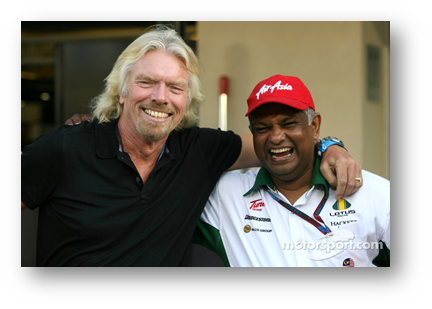
Tan Sri Tony Fernandez & Richards Branson.

Figure 2: Tan Sri Tony Fernandez & Richards Branson (Source: Google image)

The strength of Tony’s transformational leadership style lies in bridging the gap between the top management and their subordinates. This enhances the conduct of business to be more productive and efficient. Tony’s leadership style gives importance towards transparency and humility. By doing this, Tony Fernandez will be more approachable by his All-Stars (staffs). According to Tony, being humble is the key to transparency and all his 17,000 staff have the ability to SMS, call and share ideas with him. Tony believes that anyone in the company could contribute ideas and will be heard, unlike decision making is being monopolized by top management in most companies. Tony added that he would rather have 17,000 brains working for him rather than just the top ten from management and disapproves the huge power distance between the CEO and staff of a company, that resulting only a few decides and the rest are merely implementers (Kamisan and King 2013).

Another example of a profound leader that practices transformational leadership would be Richard Branson, the founder of Virgin Atlantic Group. According to Branson, if a leader is able to motivate their subordinates and uses their potential creatively, a company will have the ability to overcome bad times and enjoy good times together. Brandon believes that the key success towards Virgin Atlantic Group is the way he motivates his employees and Branson gives his staff the freedom to work without much interference from the top management (Chris 2015).

Conclusion

In conclusion, leadership style should encompass as described and it plays an important role towards the success of a team through sharing objectives, values, trust and upholding transparency. Without a doubt I would like to picture myself working in a company that practices lesser power distance and leaders who hear us.

(741 Words)

Reference

Bass, B. (2010). The Bass handbook of leadership: Theory, research, and managerial applications. New York, NY: Simon & Schuster.

Bennis, W. G. and Nanus, B. (1997), Leaders: The Strategies for Taking Charge, HarperCollins, New York.

Capowski, G., (1994), ―Anatomy of a leader: where is the leader of tomorrow?‖, Management Review, Vol. 83 Issue 3, p. 10- 18.

Chris, J. (2018). Richard Branson Leadership Style Commandments –  Joseph Chris Partners. [online] available from http://www.josephchris.com/richard-branson-leadership-style-commandments [21 Oct 2018].

CMI (2012) Henri Fayol Planning Organisation Command Coordination Control [online] available from <https://www.managers.org.uk/~/media/Campus%20Resources/Henri%20Fayol%20%20Planning%20organisation%20command%20coordination%20and%20control.ashx&gt; [8 October 2018]

Godwin, A. (2017) ‘Application Of The Henri Fayol Principles Of Management In Start Up Organisations’. IOSR Journal Of Business And Management [online] available from <http://www.iosrjournals.org/iosr-jbm/papers/Vol19-issue10/Version-4/K1910047885.pdf&gt; [8 October 2018]

 Kamisan, A. and King, B. (2013)”Transactional And Transformational Leadership: A Comparative Study Of The Difference Between Tony Fernandes (Airasia) And Idris Jala (Malaysia Airlines) Leadership Styles From 2005-2009″. International Journal Of Business And Management 8 (24)

Kaplan (2019) Fayol’s Five Functions Of Management [online] available from <http://kfknowledgebank.kaplan.co.uk/KFKB/Wiki%20Pages/Fayol%27s%20five%20functions%20of%20management.aspx&gt; [27 June 2019]

Katz, R. L. (1955). Skills of an effective administrator. Harvard Business Review, 33(1), 33-42. Kotterman, J., (2006), ―Leadership vs Management: What‘s the difference?‖, Journal for Quality & Participation, Vol. 29 Issue 2, p.13-17

Kotter, J. P. (1990b). A force for change: How leadership differs from management. New York, NY: Free Press.

Kotter, J. P., (2001), ―What leaders really do?―, Harvard Business Review, Vol. 79 Issue 11, p.85-96

Lombardo, C. (2019) 10 Disadvantages Of Transformational Leadership [online] available from <https://futureofworking.com/10-disadvantages-of-transformational-leadership/&gt; [27 June 2019]

Luthar, H. K. (1996, September). Gender differences in evaluation of performance and leadership ability: Autocratic vs. democratic managers. Sex Roles, 35, 337-360.

Mullins, L. J. (2010). Management and Organizational Behavior. UK: Pearson Education. Northouse, P. (2007). Leadership theory and practice. Thousand Oaks, CA: Sage Publications. Phi Theta Kappa. (1991). Creating then communicating your vision. In Phi Theta Kappa, Leadership Development Program. Jackson, MS: Phi Theta Kappa, p.2.2.

News, A. (2019) Airasia CEO: Positive Thinker, Unusual Leader [online] available from <https://news.abs-cbn.com/business/11/18/15/airasia-ceo-positive-thinker-unusual-leader&gt; [27 June 2019]

Wajdi, B. (2017) “The Differences Between Management And Leadership”. Sinergi : Jurnal Ilmiah Ilmu Manajemen [online] 7 (1). available from <https://www.researchgate.net/publication/318597967_The_Differences_Between_Management_And_Leadership&gt; [27 June 2019]

The Challenge of Managing Diverse Teams.

There is a saying goes by Stephen Covey (1989), “strength lies in differences, not in similarities”. In the direction of globalization, diversity has become exceptionally essential in an organization. Age, cultural background, physical abilities and disabilities, race, religion, and gender are the attributes associated to a diverse workplace (Saxena 2014).

Ever since globalization took its place, most organization has turned their attention towards workplace diversity, where they hire employees from various background to remain relevant in their businesses and to partake in market share. According to Bedi, P., Lakra, P. and Gupta, E. (2014) when workforces are being exposed to new cultures, ideas and perspectives, it helps to them reach out rationally and have a clear understanding of global environs. Hence the team has a higher degree of shelving different ideas and offer a unique problem solving ideas by effectively giving the best solution at the shortest possible time.

Leaders, supervisors or managers should value their diverse team background within their organization so that their subordinates will be treated with dignity and respect. Diversity in an organization is beneficial because by respecting an individual differences can increase productivity.

As much as we lay out the benefits of diversity, in contrast there are some challenges of diversity in workplace. Superiority or supremacy that encourages a certain group, race, or religion being treated as superior possess high likelihoods of blaming the ‘minorities’, discriminating against them and verbal or physical harassment could restrict them towards adapting the new environment. Language barriers could lead to miscommunication and misunderstanding in a team that is diverse. Briefly, an organization with diverse team must be led by a leader who will be able to manage the team through its differences and elevate them to their full potential and thus increases productivity. Diversity has been a long debate among researchers and there are various team building models being invented along these years. Tuckman’s model of team development could be one of the easiest model that can be used by all leaders to increase productivity among diverse subordinates (Tuckman & Jensen 1977). Tuckman suggests that there are 6 stages to endure in order for a team to develop, namely Forming, Storming, Norming, Performing and Adjourning

Forming is when leaders and subordinates gets to know each other and focuses on setting targets and delegating tasks. Storming is where team member’s starts to lay opinions that differs and working through conflicts and moving towards goal settings. Norming is when conflicts has reduced, ground rules are formed and relationship being established between subordinates. Performing, is when the team is dedicated to complete the tasks and decision making is done collectively. The final stage, adjourning is when the team has completed the tasks and performance evaluation are done at this stage. Team members celebrates success or learn from experience.

Limitation towards Tuckman’s model will be, there is no specific timeline to adhere to. For instance, if a team has failed in norming stage, they shall return to storming or forming stage. (Tuckman, B.W. & Jensen, M.C, 1977).

3M has been a great example towards building the diverse culture. According to 3M, they have established a goal to double diverse talent in management by 2025 across all countries and they made progress. Thus far, more than 50 percent from their top 100 leaders are diverse, and 30 percent of 3M board members are women. Mike Roman CEO for 3M, has formed a CEO Inclusion Council that consists a group of diverse 3M leaders from across the globe that focuses on elevating and prioritizing actions to build a more inclusive and competitive workplace. Mike also signed the Catalyst CEO Champion for Change pledge and helps to build workplaces that work for women (women friendly) and made strong organizational commitments to support diversity, inclusion and gender equality at work. 3M reflects the diversity of their global customers, suppliers and channel partners, and build on each individual employee’s abilities and diverse backgrounds.

To conclude, a wise leader would ensure the team feels valued and included by treating everyone with fairness and uphold equality. Though diversity could be a reward to an organization, but to manage a diverse team could be challenging.  An organization should guarantee of fair treatment, accessibility, opportunity and advancement for all individuals and create an environment where their team feel safe to engage and participate to the fullest. By doing so, they will feel respected, comfortable to express their ideas, and value them for their unique voice and abilities.

References

Bedi, P., Lakra, P. and Gupta, E. (2014) Workforce Diversity Management: Biggest  Challenge Or Opportunity For 21St Century Organizations [online] available from <http://iosrjournals.org/iosr-jbm/papers/Vol16-issue4/Version-3/P01643102107.pdf&gt; [5 June 2019]

Hudson, Jr, S. (2014) “Diversity In The Workforce”. Published By American Research Institute For Policy Development [online] Vol. 3 (No. 4). available from <http://dx.doi.org/10.15640/jehd.v3n4a7&gt; [5 June 2019]

Nafukho, F., Wawire, N. and Lam, P. (2011), Management of Adult Education Organizations in Africa: African Perspectives on Adult Learning, UNESCO, Hamburg.

Saxena, A. (2014) “Workforce Diversity: A Key To Improve Productivity”. Procedia Economics And Finance 11 ( 2014 ) 76 – 85

Tuckman, B.W. & Jensen, M.C (1977). Stages of small-group development revisited.  Group & Organization Management, 2(4), 419-427. 3M.com. (2019). Ethics & Compliance | 3M’s Code of Conduct | 3M United States. [online] Available at: https://www.3m.com/3M/en_US/ethics-compliance/code/ [Accessed 6 JUNE 2019].

Leadership and Ethics

Significance of leadership lies between a leader and their follower within an organization (Rost, 1993). Leaders are meant to be the main source of ethical guidance to their subordinates and should take full responsibility towards their moral development within an organization. Ethics is also acknowledged as the moral philosophy which studies the variances between what is right and wrong (Association of Chartered Certified Accountants 2018, Singer 2018).  According to Sims (1992), ethical behavior is behavior that accepted as good/right and contradictory of bad/wrong in a given situation.


Figure 1: Deontological and Teleological Framework

There are two theories that I have chosen to discuss namely Teleological and Deontological. Teleology (Consequentialism) is an approach to ethics that focuses on the consequences of an actions (Penn State University, 2016). On the other hand, Deontology, in contrast to teleology, focuses on the process of the actions taken, generally while following a moral code (Penn State University, 2016). Let us dive into an example to get a clearer picture of these theories. Recently, in the month of February 2019, Sarawak has carried out an operation called ‘Integrated Rabies Operation’, to vaccinate dogs and remove (eradicate) strays due to the disease has claimed 16 lives and left other survivors in critical condition. From teleological point of view, removing the infected stray dogs is a good move, to prevent rabies from spreading and harm more the livings. Where else, from Deontological perception, removing the infected dogs is extremely unethical because the infected dogs has life too. Hence, by looking at the magnitude of this operation, killing the infected strays is definitely not ethical, but the outcome of this operation will certainly benefit the livings.

Figure 2: 4-V Model of Ethical Leadership – (The Center for Ethical Leadership 2014)

Dr Bill Grace based on his years of research and passion towards faith and ethics has developed an ethical leadership framework namely ‘4V’ that aligns the beliefs and values (internal) with the behaviors and actions (external) for the sole purpose of progressing the collective good. According to Dr Subashree (2014), people who wants to become an ethical leader should uphold the ‘inner journey’ of integrity which helps to identify the core values and develop visons of changing the world which is the ‘outer commitment’ that ultimately serves the community and progress the common good. Leadership aims to shape a visionary, inclusive future that will enable all members of society to fulfill their needs, dreams and potential.

Values Understanding personal core values
Vision Vision the ability to frame our actions
Voice Voicing our vision in a convincing and authentic manner
Virtue Common good by understanding the values, vision and voice.

Figure 3: Defined 4-V Model of Ethical Leadership

Figure 4: 3M Headquarters

3M has been named one of the 2019 World’s Most Ethical Companies by Ethisphere for the sixth year in a row (Ethisphere® Institute | Good. Smart. Business. Profit.®, 2019). Ethics are the foundation of 3M and it is built into the culture of 3M. Every decision that the leaders make are guided by the book of conduct. It is the responsibility of everyone that is attached to 3M to raise concerns and ask questions if something appeared to be not right. Employees must exercise good judgment in their decisions for 3M, always in a way that is consistent with the Code. Employees are also expected to support others’ compliance with the Code, which means that they must report suspected Code violations. Supervisors and managers set the tone for their teams and required to set a strong example of ethical conduct and to provide training, education, and resources to support employees in complying with the Code. Encourage employees to speak up if they have questions or concerns and discipline misconduct and reward good behavior.

Figure 5: Volkswagen Headquarters

On the other hand, Volkswagen (VW) had a bad reputation of being an unethical company back in 2015. VW failed to meet the required emissions standards on their diesel vehicle and instead of fixing the problem, two of their employees installed a software in their 11 million diesel powered vehicles worldwide that is aimed to beat the emission test and the results were used to promote VW ‘clean diesel’ vehicle technology worldwide (Stan, 2018). According to Glazer (2016), Martin Winterkon managerial style was labelled authoritarian that fosters fears among subordinates and discourages open dialogue. A company that install fear among employees to raise questions and limits check and balance is prone to cheating and fraud (Glazer, 2016). The consequences leads Volkswagen to receive notice of violation from the Environmental Protection Agency, criminal investigation by the U.S. Department of Justice and dozens of class-action lawsuits against Volkswagen. To conclude, ethical management is vital towards sustainability of an organization. A leader plays an important role in an organization to inspire and to make valuable decision. Fostering value based leadership will create a strong ethical culture and creates an effective management.

To conclude, ethical management is vital towards sustainability of an organization. A leader plays an important role in an organization to inspire and to make valuable decision. Fostering value based leadership will create a strong ethical culture and creates an effective management.

References.

Association of Chartered Certified Accountants (2018) What is ethics? [online] available from<https://www.accaglobal.com/my/en/member/standards/ethics/what-is-ethics.html#&gt; [19 September 2018]

Dr Subhasree, K 2010,’ Ethical Leadership: Best Practice for Success’, Journal of Business and Management, pp. 112 – 116

Glazer, R. (2016). The Biggest Lesson from Volkswagen: Culture Dictates Behavior. Entrepreneur. Available at: http://entm.ag/1PdLlw3 [Accessed 20 May 2019].

Penn State University. (2016). PSY533 SP16 Lesson 03: Ethical Theories. [Online lecture]. Retrieved January 25, 2016, from https://psu.instructure.com/courses/1775390

Rost, J. C. (1993). Leadership for the twenty-first century: Praeger Publishers

Sharon Ling (2019) ‘Integrated op to control Sarawak rabies outbreak’
the star [online] 27 February 2019 https://www.thestar.com.my/news/nation/2019/02/27/integrated-op-to-control-sarawak-rabies-outbreak/#0sIB4AWRtOtpfScq.99 [Accessed 20 May 2019].

Silverman, S. (2015). VW employees responsible for ‘Dieselgate:’ Where’s the legal, moral, & ethical compass?.[online] Bizjournals.com. Available at: https://www.bizjournals.com/philadelphia/morning_roundup/2015/10/volkswagen-dieselgate-legal-ethics-silverman.html [Accessed 20 May 2019].

Sims, R. R. (1992). The challenge of ethical behavior in organizations. Journal of Business Ethics, 11(7), 505-513.